

“You can’t manage what you can’t measure.” — Peter Drucker
India’s manufacturing sector is on a historic growth trajectory, driven by the Make in India initiative, rising domestic consumption, and global supply chain diversification. Yet, most manufacturing Small and Medium Enterprises (SMEs) still rely on gut instinct, spreadsheets, and reactive decision-making rather than real-time data.
The result? Missed delivery deadlines, rising input costs, shrinking margins, and lost customers to more agile competitors.
Tracking the right Key Performance Indicators (KPIs) is not a luxury reserved for large corporations. It is the single most important discipline that separates growing manufacturing SMEs from stagnant ones. At IMCGlobal, our ERP solutions are purpose-built to help Indian manufacturers monitor, analyse, and act on exactly these metrics — in real time.
In this post, we break down the 10 most critical KPIs for manufacturing SMEs in India, why each one matters in the Indian business context, and how to start measuring them today.
Indian manufacturing SMEs operate in one of the world’s most competitive and price-sensitive environments. Thin margins, volatile raw material costs (especially post-2022 global disruptions), skilled labour shortages, and increasing compliance demands mean that any operational inefficiency directly impacts the bottom line.
KPIs give SME owners and plant managers a shared language of performance. When tracked consistently through an integrated ERP system, they transform raw operational data into actionable business intelligence – enabling faster decisions, smarter resource allocation, and sustainable growth.
Let us now explore the 10 KPIs every manufacturing SME in India must track in 2025.
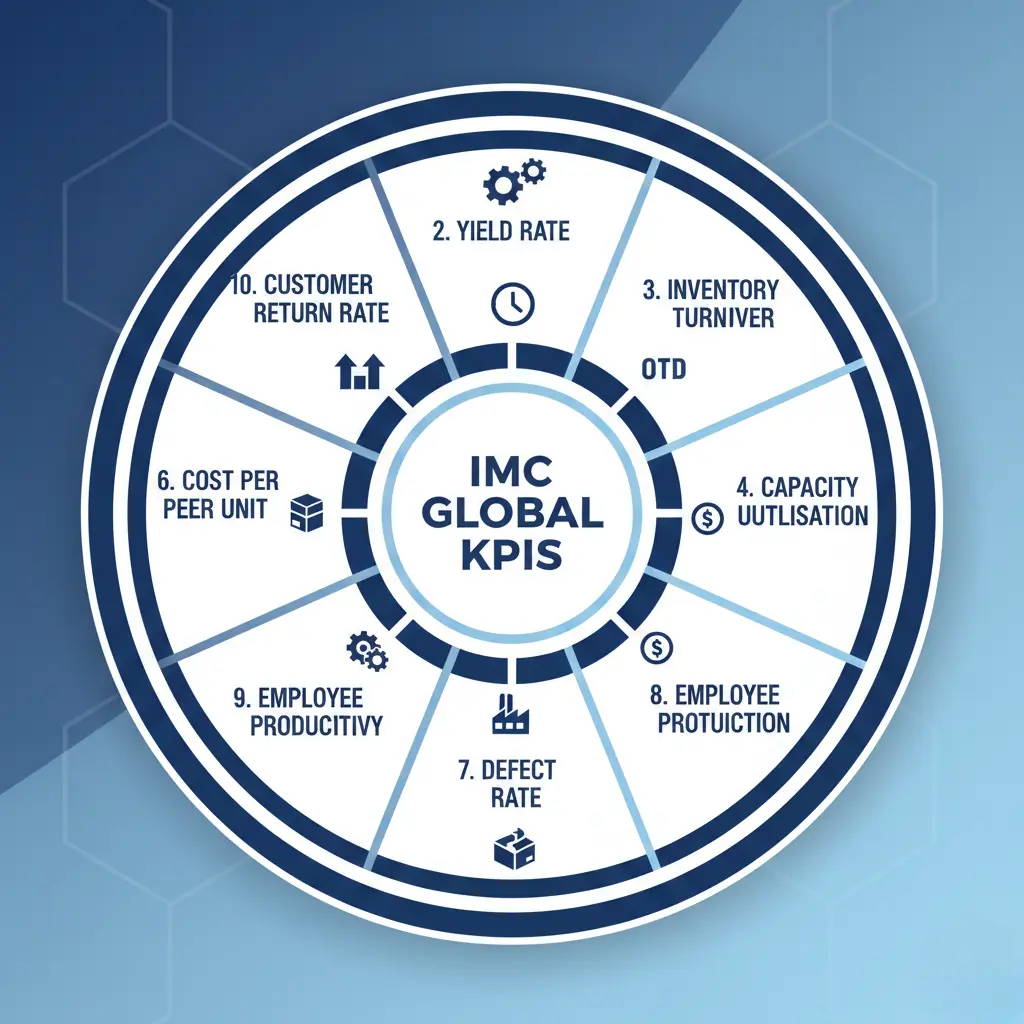
| KPI #1: Overall Equipment Effectiveness (OEE) |
|
What It Means: OEE is the gold standard of manufacturing performance. It measures how effectively a manufacturing operation is utilised compared to its full potential, combining availability, performance, and quality into a single metric. Formula: OEE = Availability × Performance × Quality Rate Benchmark Target: World-class: 85%+. Indian SME average: 45–60% (significant room for improvement). Why It Matters for Indian SMEs: Many Indian SMEs run ageing machinery with poor maintenance schedules, leading to frequent downtime. A low OEE score immediately reveals whether losses stem from equipment breakdowns, slow running speeds, or quality defects — enabling targeted corrective action. |
| KPI #2: Production Yield Rate |
|
What It Means: Yield rate measures the percentage of products manufactured correctly on the first pass — without rework, scrap, or rejection. Formula: Yield Rate = (Good Units Produced ÷ Total Units Started) × 100 Benchmark Target: Target: 95%+ for most manufacturing sectors. Why It Matters for Indian SMEs: With rising raw material costs (steel, plastics, chemicals), even a 2–3% improvement in yield rate can translate to lakhs of rupees saved annually. Poor yield often points to process inconsistencies, untrained operators, or substandard input materials — all fixable with the right data. |
| KPI #3: On-Time Delivery (OTD) Rate |
|
What It Means: OTD measures the percentage of customer orders fulfilled by the committed delivery date. Formula: OTD = (Orders Delivered On Time ÷ Total Orders) × 100 Benchmark Target: Target: 95%+. B2B manufacturing benchmark in India: 80–90%. Why It Matters for Indian SMEs: Indian manufacturing buyers — whether domestic distributors or global OEM clients — are increasingly demanding just-in-time delivery. A poor OTD rate directly triggers customer complaints, penalty clauses, and eventually loss of repeat business. Tracking OTD forces better production planning and supply chain coordination. |
| KPI #4: Inventory Turnover Ratio |
|
What It Means: This KPI measures how many times your inventory is sold and replaced over a given period, reflecting the efficiency of your inventory management. Formula: Inventory Turnover = Cost of Goods Sold (COGS) ÷ Average Inventory Value Benchmark Target: Target: Industry-specific; typically 6–12x per year for fast-moving manufacturing sectors. Why It Matters for Indian SMEs: Overstocking ties up critical working capital — one of the most common challenges for Indian SMEs who often bulk-purchase to avoid price hikes. Understocking causes production stoppages. Tracking this KPI helps strike the right balance and significantly improves cash flow. |
| KPI #5: Manufacturing Cost Per Unit |
|
What It Means: This KPI calculates the total cost (materials, labour, overhead) required to produce one unit of finished product. Formula: Cost Per Unit = (Total Manufacturing Cost ÷ Total Units Produced) Benchmark Target: Target: Decreasing trend quarter-over-quarter while maintaining quality. Why It Matters for Indian SMEs: With GST compliance, labour cost inflation, and energy price volatility, understanding unit economics is critical for Indian SMEs that bid on tenders or negotiate B2B contracts. A rising cost per unit without a corresponding price increase erodes margins invisibly — until it is too late. |
| KPI #6: Capacity Utilisation Rate |
|
What It Means: Measures the percentage of total production capacity actually being used during a given period. Formula: Capacity Utilisation = (Actual Output ÷ Maximum Possible Output) × 100 Benchmark Target: Target: 75–85% for sustained operations (above 85% risks burnout; below 70% signals inefficiency). Why It Matters for Indian SMEs: Many Indian SMEs either overinvest in capacity that sits idle, or run machines at 100% and face quality drops and machine failures. Monitoring this KPI helps optimise shift scheduling, machine allocation, and new capital investment decisions. |
| KPI #7: Defect Rate (Parts Per Million — PPM) |
|
What It Means: Defect rate tracks the number of defective products produced per million units manufactured, a common quality standard used in B2B supply chains. Formula: Defect Rate (PPM) = (Defective Units ÷ Total Units Produced) × 1,000,000 Benchmark Target: Target: Varies by sector — automotive SMEs supplying OEMs often need to achieve <50 PPM. Why It Matters for Indian SMEs: As Indian manufacturers increasingly target export markets and supply to global Tier-1 companies, defect rate becomes a gateway KPI. High defect rates signal process instability and will disqualify SMEs from premium supply chain partnerships. |
| KPI #8: Employee Productivity Rate |
|
What It Means: Measures the output generated per employee (or per labour hour), a direct indicator of workforce efficiency. Formula: Employee Productivity = Total Output Value ÷ Total Labour Hours Worked Benchmark Target: Target: Sector-specific; track trend over time (quarterly improvement of 3–5% is a strong indicator). Why It Matters for Indian SMEs: Labour remains one of the highest variable costs for Indian manufacturing SMEs. Tracking productivity by shift, department, or individual helps identify training needs, incentive opportunities, and process bottlenecks. It also informs automation investment decisions. |
| KPI #9: Maintenance Cost as % of Asset Value |
|
What It Means: This KPI tracks total maintenance expenditure relative to the total value of production assets — distinguishing between planned preventive and reactive breakdown maintenance. Formula: Maintenance Cost % = (Total Maintenance Cost ÷ Total Asset Value) × 100 Benchmark Target: Target: 2–5% for modern facilities; if above 10%, urgent asset review is needed. Why It Matters for Indian SMEs: Unplanned machine breakdowns are one of the top causes of production losses in Indian SMEs. Many businesses underinvest in preventive maintenance until a costly breakdown forces their hand. This KPI supports a proactive maintenance culture and helps justify planned maintenance schedules. |
| KPI #10: Customer Return Rate (Rejection Rate from Customers) |
|
What It Means: Tracks the percentage of finished goods returned by customers due to quality issues, wrong specifications, or damage. Formula: Customer Return Rate = (Units Returned ÷ Units Delivered) × 100 Benchmark Target: Target: <1% for most sectors; <0.5% for precision manufacturing. Why It Matters for Indian SMEs: In an era of online reviews, social media, and tight-knit B2B trade networks in India, a high return rate destroys reputation faster than any competitor can. This KPI closes the loop between production quality and customer satisfaction — and is a leading indicator of future revenue risk. |
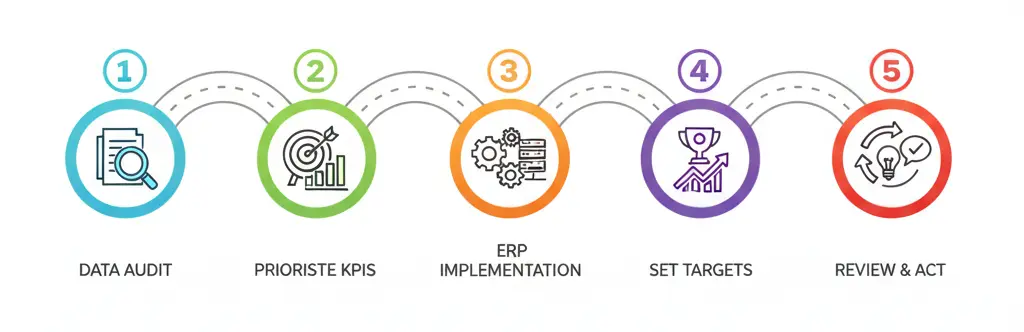
Step 1 – Audit Your Current Data Sources
Before you can track KPIs, you need to know where your operational data currently lives — be it factory floor registers, Excel sheets, or accounting software. Identify data gaps immediately.
Step 2 – Prioritise 3–5 KPIs to Start
Do not try to implement all 10 KPIs simultaneously. Begin with the metrics most aligned to your current pain points — for example, OEE and OTD if delivery reliability is your biggest challenge.
Step 3 – Implement an Integrated ERP System
Manual KPI tracking is unsustainable. A manufacturing ERP like IMCGlobal’s solution centralises data from production, inventory, procurement, quality control, and finance — enabling automatic, real-time KPI dashboards without manual data entry.
Step 4 – Set Baseline and Targets
Record current performance levels as your baseline. Set quarterly improvement targets that are ambitious but realistic. Involve your plant supervisors and department heads in setting these targets to drive ownership.
Step 5 – Review Weekly, Act Daily
KPIs are only useful if they drive decisions. Schedule weekly KPI review meetings with key stakeholders. Build daily floor-level habits that contribute to KPI improvement — shift handover reports, quality checks, machine log updates.
At IMCGlobal, we understand that Indian manufacturing SMEs face unique challenges — from multi-location production units and complex GST compliance to Tier-2 city infrastructure and diverse workforce skill sets.
Our ERP platform is specifically designed to bring enterprise-grade performance intelligence to SMEs, at a cost and complexity level that makes sense for businesses with 20 to 500 employees. With IMCGlobal, you get:
- Real-time KPI dashboards across production, quality, and supply chain
- Automated alerts for KPI deviations before they escalate into crises
- GST-ready financial reporting integrated with manufacturing data
- Implementation support from manufacturing ERP specialists with India-specific expertise
- Scalable modules that grow with your business — from single plant to multi-site operations
Stop guessing. Start measuring. And watch your manufacturing business transform.
The manufacturing SMEs that will lead India’s industrial growth story over the next decade will not be the ones with the biggest factories or the most machines — they will be the ones that make the smartest, fastest decisions based on real data.
Tracking KPIs for manufacturing SMEs in India is not about creating complex reports. It is about building a culture of continuous improvement, one metric at a time. Start with the 10 KPIs outlined above, implement a robust ERP system to track them, and commit to weekly review rituals that translate data into action.
IMCGlobal is ready to be your partner in that journey. Contact us today for a free manufacturing ERP consultation tailored to your business.
Ready to track your manufacturing KPIs in real time? Book a free demo with IMCGlobal at imcglobal.com and see how our ERP transforms your operations.
